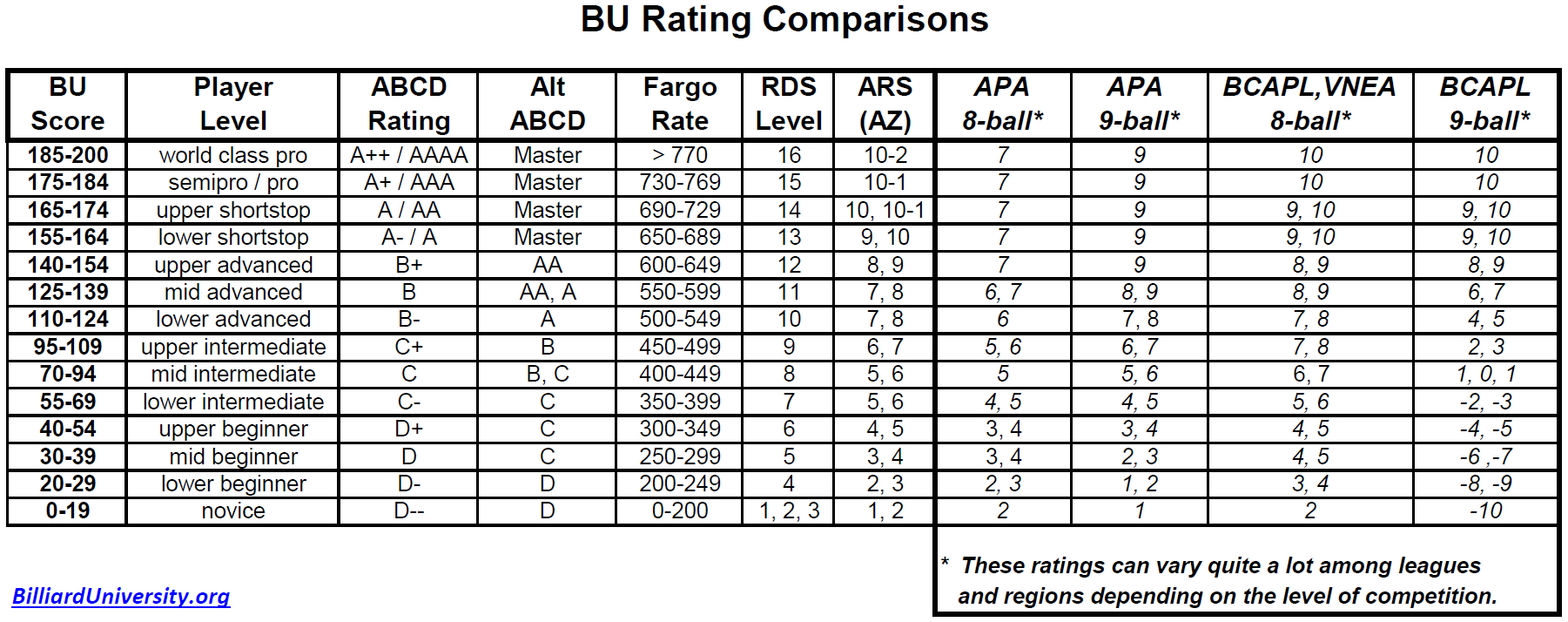
player ratings

 Dr. Dave's answers to frequently-asked questions (FAQs),
mostly from the BD CCB and AZB discussion forums

maintained for the book: The Illustrated Principles of Pool and Billiards,
the DVD series: The Video Encyclopedia of Pool Shots,
and the monthly Billiards Digest "Illustrated Principles" instructional articles


9-ball rating drill

Is there a drill that can be used to measure my level of play?

I have a 9-ball rating drill that can be used to rate a player and track improvement over time. The purpose of this drill is to evaluate your offensive skills (shot making, position play, handling of clusters and problem balls, and breaking) and assign a 1-10 (or A-D) rating to those skills. Note - safety play, a very important part of the game, is not addressed in this drill.

More rating drills can be found under drills here.

from Eric.:

Joe Tucker has a thing he uses that proves to be pretty accurate. It goes like this:

Rack up some 10 ball. Break from anywhere. After the break, take ball in hand and run out, in rotation (1, 2, 3, etc...) All balls made on the break count. Any balls made on a scratch are spotted. Once you miss, the rack is over. You should shoot 10 racks and count the total balls made for each rack. After 10 racks, take your total and compare it to this chart:

30-35 D+
36-40 C
41-45 C+
46-50 B
51-55 B+
56-60 A
61-65 A+
66-70 A++
71-up Pro

I'm not sure if it matters what size table. I like this rating system because it takes a lot into account as far as player ability i.e. shotmaking, position play, cluster breaking, break skill. It makes no difference if you play 10 ball or not, the results are very close to reality.


Accu-Stats TPA

How does Accu-Stats' player rating system work?

The Tournament Performance Average (TPA) can be used to measure a player's performance in a match or tournament. It is a single number (like a batting average) based on the following formula:

TPA = (# of Balls Made) / (# of Balls Made + # of Errors)

Errors are any of the following:

For example, if you make 100 balls in a match and commit 25 errors, your TPA would be 0.8 or 80% (100/125). A perfect score, with no errors, would be 1.0 or 100%.


A-D rating system

How do you interpret the letter ratings (A-D) sometimes used to refer to player ability?

from Tom_In_Cincy:

9-Ball Tournament race to 7
(paraphrased from Dec.1997 "All About Pool" magazine article by Bob Cambell)

Handicap rankings

D- Player
will not run a rack
average run is about 3 balls
with ball in hand, will get out from the 7, one out of 3 times
rarely plays a successful safe

C-Player
will probably run one rack, but usually not more than one rack in a typical race to 7
avg. run is 3 to 5 balls
with ball in hand, will get out from the 7, two out of 3 times
mixed results when playing safe
inning ends due to botched position, missed shot or attempting a safe.

B-Player
Able to run 1 to 3 racks
avg. run is 5-7 balls
with ball in hand will get out form the 5, 2 out of 3 times
most of the time a "B" player will play a "safety" which maybe hit easily 2 out of 3 times
a typical inning will end with a missed shot, a fair safety, or a won game

A-Player
will string 2 to 3 racks
avg. ball run, 7-9
with ball in hand, will be out from the 3 ball, 2 out of 3 times
typical inning will end with a well executed safety or a win.

OPEN-Players
average 8+ balls
string racks together more than once in a match
is a threat to run out from every ball, from every position, every inning
typical inning will end in excellent safety or win

Mr. Cambell continues this article with a handicap chart for the 4 levels of each type of player. The chart would look like this;

Lowest handicap is D4, then D3, then D2 and so on until the highest would be OPEN 1

from Jude Rosenstock:

D - Will appear as though they are stumbling through the rack. Their occasional run-outs will either consist of very easy layouts (which they will nearly mess-up), a few lucky shots and/or unintentional position.

C - Greater sense of cue control and much more of a deliberate appearance than a D. They will undoubtedly run out with BIH with 3 or 4 left and will make it look routine but are suspect beyond that.

B - Really the beginning of the run out player. If they make a ball on the break and get position on the 1 ball, they should have a reasonable expectation to get out. Any cluster or unusual position play will diminish their chances significantly. Usually, B players possess unusual strength in either pocketing, strategy or position play. Rarely two of three, never all three. Their creativity is usually limited at this level but you may begin to see glimpses of what's to come.

A - Definitely catagorized as a run out player. They are supposed to capitalize on most mistakes. Greater attention is paid to more subtle details. Expect a consistent and strong break and strength in multiple attributes (pocketing, defense, position play, creativity). Most noticeable among players at this level and above is an aura of confidence.

Open & Above is very similar to what you see described in A only more refined. You will see advanced to expert break, pocketing, defense, position play and creativity. Low level opens might be advanced in all of these catagories while world class professionals might be experts in most or all. All of these players are expected to run out with any routine opportunity. Any run-stopper situation (clusters, blocked position routes) is expected to be handled in such a way to still give the shooter an expectation of winning.


Arizona 1-10 rating system

How does the 1-10 rating system developed in Arizona work and compare to other ratings?

See the following resources:

Here's how the Arizona Ratings compare to the "National Scale" (from: www.arizbilliardsdirectory.com/conversions.html):

AZ        Nat.       Descriptipon
10-2      A+        Top professional. World class player. Capable of winning major professional tournaments. Almost always finishes in the money in any tournament entered.

10-1      A           Professional, or player possessing professional skills. Capable of winning local open tournaments. Usually finishes in the money in regional tournaments.

10          A-         Semi-pro, or player possessing professional skills. Capable of winning or placing high in the money in local open tournaments.

9            B+         Advanced. Very good position play, strategy and consistency. Top league player. Consistent competitor in local open tournaments.                      

8            B           Advanced. Good position play, strategy and consistency. Good league player. Competitive in local open tournaments.

7            B-          Intermediate. Fair amount of knowledge and experience, but inconsistent in execution. Average league player.

6            C+         Intermediate. Has learned quite a few shots, but has a lot to learn about position play and strategy. Inconsistent.

5            C            Novice. Has a grasp of the fundamentals, but does not know much about the physics of the game. Lower-level league player.

4            C-           Novice. Very basic knowledge of the fundamentals. Knows almost nothing about position play. Lowest-level tournament player.

3             D+         Novice. Knows little about the fundamentals, but might know a couple of shots. Average social player.

2             D           Novice. May not know anything about the fundamentals or making shots. Non-competitive.

1             D-          Novice. Knows nothing about the game except maybe a few rules of play.


Pool Quotient (PQ) progressive-drill ability test

Is there a set of drills I can use to get a good measure of my overall ability?

The Pool Quotient (PQ) ability test, based on progressive practice drills is a good tool to measure ability and track improvement over time. Here it is: PQ Ability Test. Other self-assessment info can be found here.